
Sustainability within reach
Gothenburg, on Sweden’s windy west coast, has built its reputation on sustainability and innovation. For Americans Peter Bergman, Meron Wonderad and Abigail Kruegle, studying at Chalmers University of Technology in Gothenburg offers the chance to learn and live where sustainability is woven into daily life. All three are recipients of the U.S. Friends of Chalmers Scholarship, which covers full tuition for top academic performers.
-
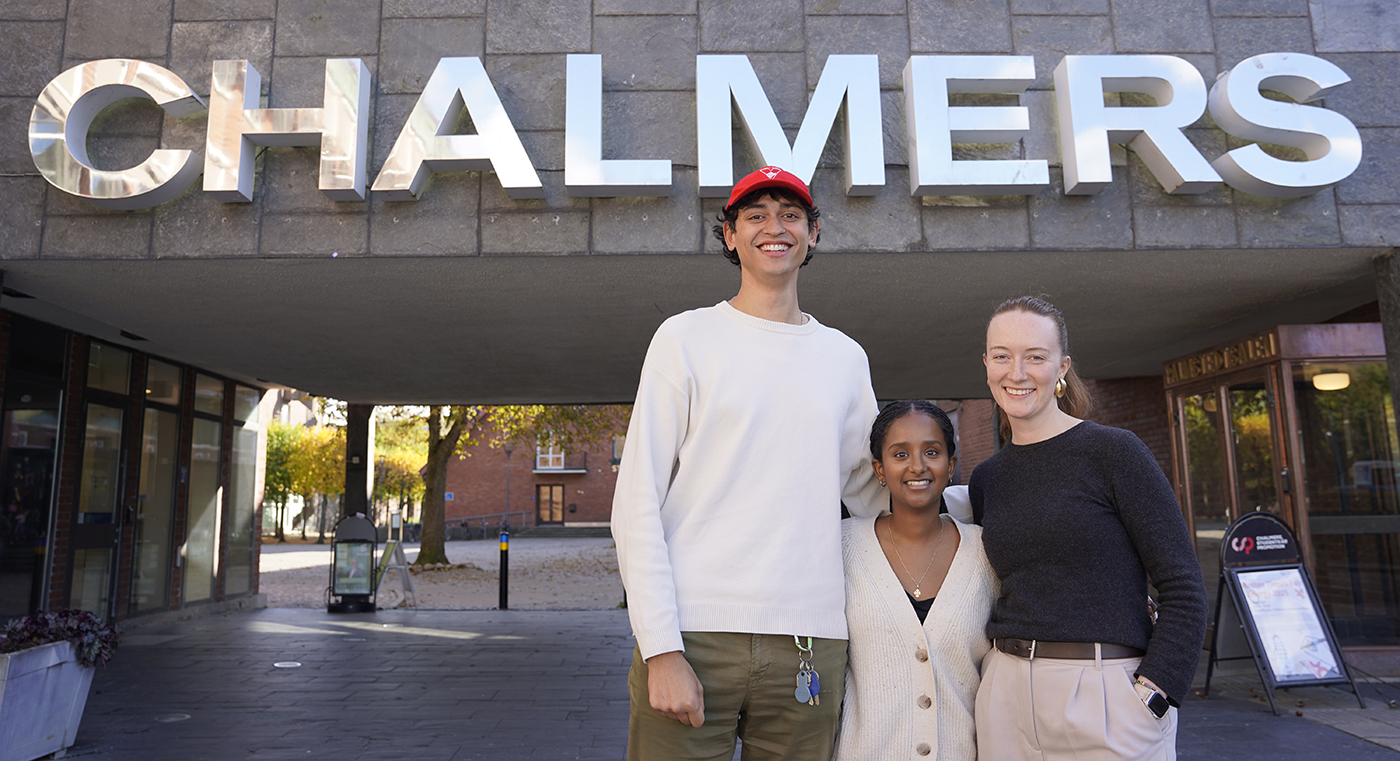 All three are recipients of the U.S. Friends of Chalmers Scholarship, which covers full tuition for top academic performers.
 -
-
Peter Bergman grew up in Minnesota, studied at Iowa State and worked for the U.S. Environmental Protection Agency before deciding to get his master’s abroad. “My girlfriend is Swedish,” he says, smiling. “I’d also heard that Chalmers was a good school, their industrial ecology program fit what I wanted to do, and getting the scholarship really sealed the deal.”
-
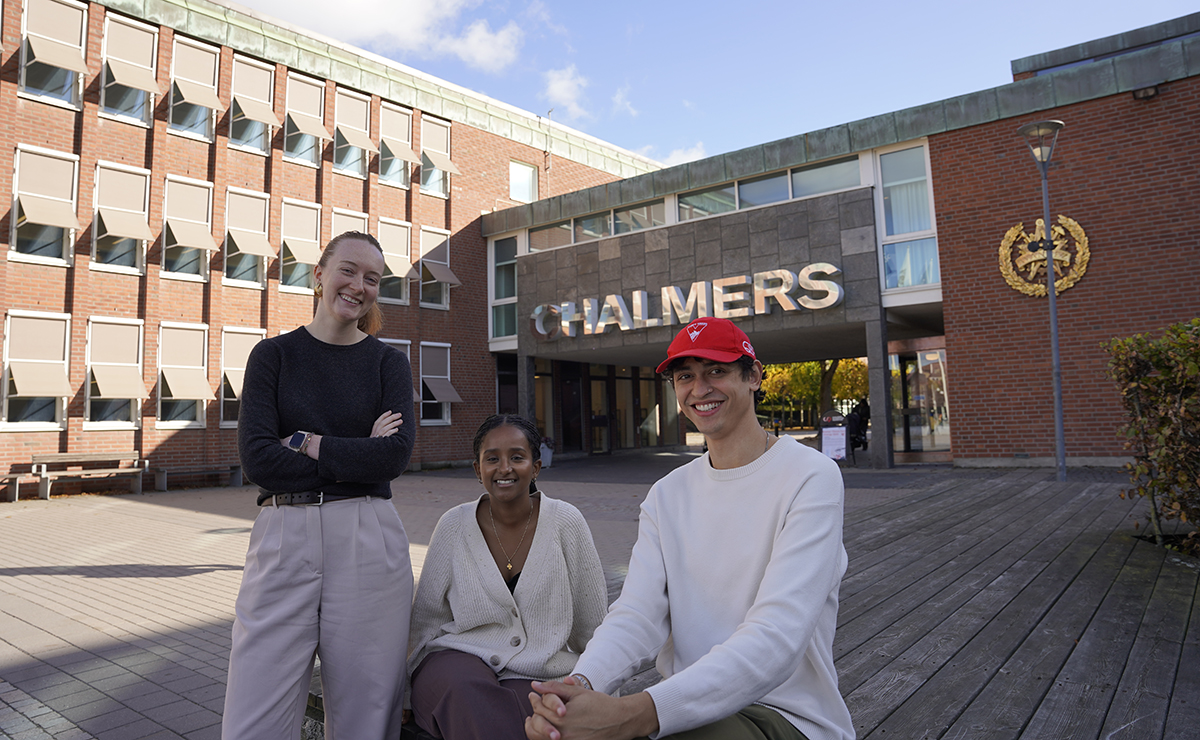 For Americans Peter Bergman, Meron Wonderad and Abigail Kruegle, studying at Chalmers University of Technology in Gothenburg offers the chance to learn and live where sustainability is woven into daily life
 -
-
Meron Wonderad came to Chalmers after several years working in biotech. “I was working in synthetic biology,” she says, “but I wanted to think about the bigger picture, how natural and biological innovation connects with sustainability.” When she found Chalmers’ industrial ecology program, everything clicked. “Europe has always appealed to me, and Sweden’s leadership in sustainability made this feel like the right place.”
-
Abigail Kruegle’s path started in Boston. With a background in bioengineering and several years as a systems engineer in medical devices, she felt drawn back to academia. “I loved my job, but I wanted to get a deeper education in foundational math and science. My husband is also studying at Chalmers, and his family lives in Sweden and Finland, so we’d talked about moving here for years.” She had previously visited Sweden but never Gothenburg. “I absolutely love it here. You can take a tram and be in the forest or by the sea in no time. The public transport is amazing. I love being so connected to many cities in Scandinavia.”
-
After they settled in, daily life started shaping how they saw sustainability. “Recycling is actually taken seriously here,” Meron says. “In the U.S., not every apartment building even has recycling. Here, it’s everywhere.” Abigail nods. “It’s almost impossible not to have a car back home. Here, I don’t need one at all, and that makes such a difference for the environment.”
-
For Peter, what stands out most is how natural it feels. “People don’t talk about sustainability all the time. They just do it,” he says. “In the U.S., people throw the wrong things into recycling bins even when it’s clearly marked. Here, everyone sorts without thinking.” Abigail agrees. “A lot of environmental talk in the U.S. is about companies trying to look green without changing much. Here, it’s just built into society. You see electric trams, proper waste sorting, no plastic cups or straws when you get take-away. You don’t have to say you care about sustainability; you just live it.”
-
Meron says settling in took a little patience. “Getting a personal number, setting up a bank account, all those practical things can take some time,” she says. “But the healthcare system blew me away. I had to get stitches once, and it cost a fraction of what it would in the U.S., even without insurance.”
-
Academically, the transition was also an adjustment. “There’s more focus on group projects here. You put in the effort you want, and that’s what you get out of it,” says Meron. Abigail describes her program, Complex Adaptive Systems, as large but tight-knit. “There are about 200 of us, but it still feels like a community,” she says. “It’s more theoretical than undergrad. It’s about understanding things deeply, not just learning how to apply them right away.”
-
When we discuss the future, the conversation quickly circles back to sustainability. Meron hopes to stay in Europe, ideally in Sweden. “I’d love to combine my biotech background with sustainability,” she says. “There’s so much potential, from developing biomaterials and sustainable textiles to helping companies manage waste or rethink their products. I know a protein engineer who worked with Lululemon to design eco-friendly fabrics, and that kind of work really inspires me.”
-
Abigail hopes to return to product development, applying what she’s learning about systems modeling to make the process more efficient and sustainable. “I loved working in design,” she says. “Now I’m learning how to model complex systems that could make that work even better.” Peter is keeping his plans flexible. “I’m into environmental tech and policy work. I’m not sure where I’ll end up, but I want to be somewhere I can make an impact.”
-
Living in Sweden and studying at Chalmers has shown them why the country is often a model for sustainability. It doesn’t feel like a slogan anymore; it’s how life works here.
“It’s reaffirmed what I already believed,” Peter says. “If you make the sustainable option easier, people will naturally choose it.”
By Vedrana Sivac -
For more information, see the Chalmers website: www.chalmers.se/masters and www.chalmers.se/scholarships
-
Facts about Chalmers University of Technology:
- Chalmers offers Bachelor, Master and PhD programs. All master’s programs are taught in English.
- Tuition fees: Master’s programs: approximately $16,000/year. Higher education in Sweden is free for students from countries within the European Union (EU), the European Economic Area (EEA) or Switzerland.
- 100% tuition fee waivers are awarded to two students with US citizenship each year for studies on Engineering master’s programmes. -
-